Hello everybody, it is Drew, welcome to our recipe page. Today, we’re going to prepare a distinctive dish, ghevar. It is one of my favorites food recipes. For mine, I’m gonna make it a little bit tasty. This is gonna smell and look delicious.
Ghevar is one of the most well liked of recent trending meals on earth. It is easy, it is fast, it tastes delicious. It’s enjoyed by millions daily. They are nice and they look fantastic. Ghevar is something that I’ve loved my entire life.
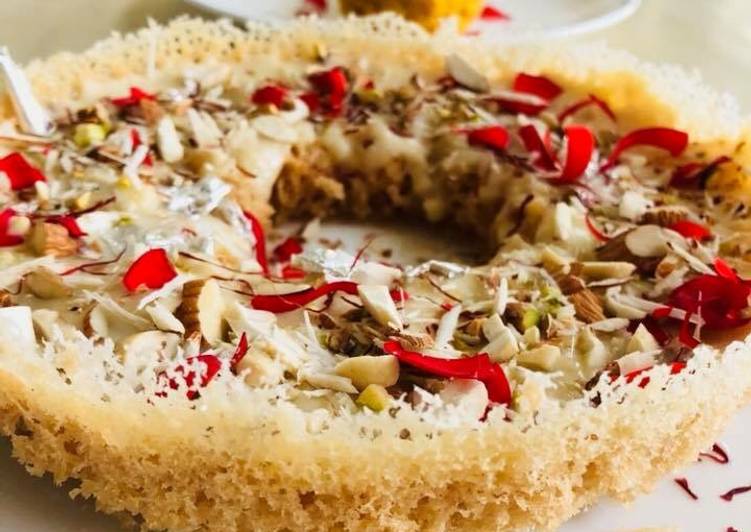
Traditional Indian sweet, ghevar is made with flour and soaked in sugar syrup. The crispy deep fried discs are soaked in sugar syrup and garnished with nuts and edible silver leaves to make a special. Ghewar or Ghevar, a true Rajasthani delicacy, is a favorite amongst all.
To begin with this recipe, we have to prepare a few components. You can cook ghevar using 6 ingredients and 7 steps. Here is how you cook that.
The ingredients needed to make Ghevar:
- Take 3/4 cups (200 grams) plain flour (maida)
- Get 1/4 cup melted ghee, cooled
- Prepare 2-3 drops kewda essence
- Prepare 1 cup sugar
- Get 1/2 cup water
- Get For the sugar syrup
Ghevar (Devanagari:घेवर) is a Rajasthani cuisine sweet traditionally associated with the Teej Festival. Besides Rajasthan, it is also famous in the adjoining states of Haryana, Delhi, Gujarat, western Uttar Pradesh, Madhya Pradesh etc. Ghevar (Devanagari:घेवर) is a Rajasthani sweet traditionally associated with the Teej Festival. It is disc-shaped sweet made with all purpose flour and soaked in sugar syrup.
Instructions to make Ghevar:
- For the sugar syrup - - Combine the sugar and water in a pan and simmer till it reaches a 1 string consistency. - Remove from the heat and keep warm.
- Combine the flour, and melted ghee in a bowl.
- Add 1 cup of water in a thin stream, whisking continuously taking care to see that an emulsion is formed and the water and ghee do not separate.
- Add 2 more cups of water again in a thin stream while whisking continuously. At no point should the ghee and water separate. - - The batter should be of a coating consistency. More water can be added if required to achieve the required consistency.
- Keep the batter in a cool place away from the heat. - Place the ghevar mould in a kadhai and pour melted ghee in it till it reaches 3/4 of the height of the mould. - Remove 2 ladles of the batter at a time into a small bowl and place it near the gas range.
- Heat the ghee on a medium flame and put in one spoonful of the batter into the mould in a thin stream. The batter should settle in the mould. - When the froth subsides, pour in another spoonful in the centre in a thin stream. - Repeat seven times making a hole in the centre of the ghevar using a wooden skewer stick. Pour the batter into this centre each time.
- Increase the flame and allow it to cook in the centre by pouring ladlefuls of hot ghee in the centre of the mould 2 or 3 times. - When the centre is firm and cooked, pull the ghevar out gently, by inserting a wooden skewer in the centre and pulling it out of the ghee. - Immerse in sugar syrup, drain quickly and place on a serving plate. - Repeat steps 7 to 13 and use the remaining batter to make 24 ghevars.
There are many varieties of Ghevar, including plain, mawa and malai ghevar. Ghevar is a quintessential dessert popular in different parts of Rajasthan. This delectable delight holds significant importance in the Indian culture and is an inevitable part of many festivals like Teej and. Once enjoyed only during the monsoon season, ghevar is nowadays available throughout the year, and it is a beloved festive dessert prepared for festivals such as Teej, Raksha Bandhan, Diwali, and Holi. If you have always Ghevar is a traditional Rajasthani sweet prepared with readily available ingredients from your kitchen.
So that’s going to wrap it up for this special food ghevar recipe. Thanks so much for reading. I’m sure that you can make this at home. There’s gonna be interesting food at home recipes coming up. Don’t forget to bookmark this page on your browser, and share it to your family, friends and colleague. Thank you for reading. Go on get cooking!